Claude God Tip #17: The Research Prompt Template (Give Claude the Unambiguous Signal)
Published: December 22, 2025 - 12 min read
In Claude God Tip #16, I promised you a Research Prompt Template to help you take full advantage of Claude's research feature. Well, here it is.
Now, I won't promise that this post will be exhaustive. There are just so many topics you could use the Research tool for, and covering every possible scenario would take forever. But I will try my best to provide you with enough information to get you thinking about better ways to structure your questions when using Claude's Research tool. This is especially important for high-stakes research where the information you retrieve needs to be as accurate as possible.
I'll also tell you what phrases to look out for in the Research Report returned by Claude that could signal how confident Claude is about the statements it makes.
Why Weak Prompts Waste Your Time
If you have ever used the research tool with a weak prompt, you have probably had Claude stop to ask you clarifying questions before it launches the research. When I say weak prompt, I don't necessarily mean a short prompt. I am usually referring to vague prompts.
For instance, if I send a prompt like this:
Is the information contained in the piece of text below valid?

[Piece of Text Here]
Claude will most likely launch the research tool immediately because it is a straightforward question that requires testing the validity of a piece of text. There is no vagueness in it.
However, if you send a prompt like this:
Research high-protein breakfast ideas
Claude would need to ask a number of clarifying questions first to ensure it covers all the bases. I actually tested this out while reading Claude's mind with the extended thinking feature turned on, and here is the thought process output I saw:
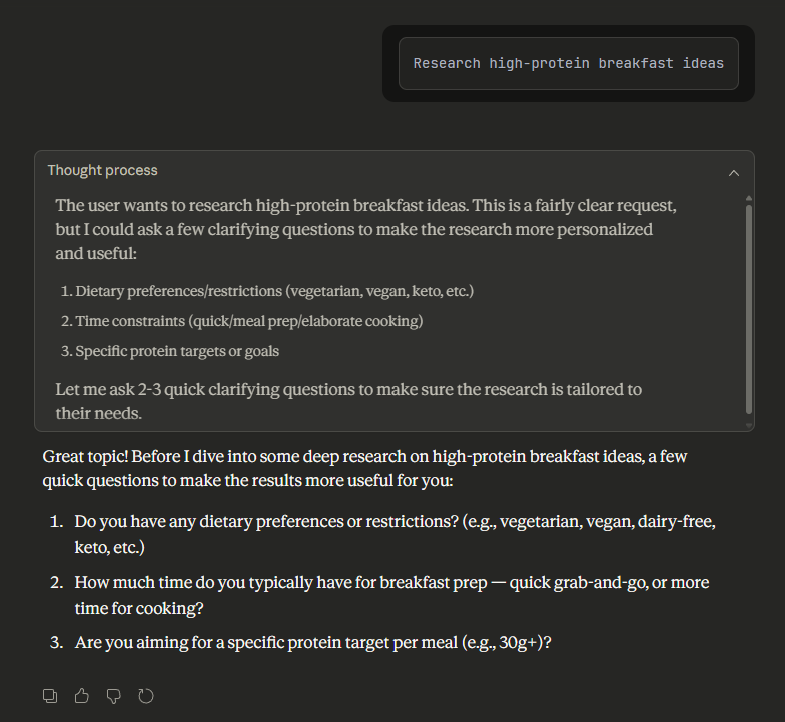
In contrast, here is Claude's thought process output when I passed a comprehensive research prompt that followed the structure I am about to teach you:
"The user has provided a very detailed research brief about LinkedIn's 360 Brew algorithm. This is a comprehensive, well-structured research request with clear objectives, specific questions, and detailed methodology requirements.
Looking at the research instructions:
Should I ask clarifying questions or launch the research task immediately? The document is extremely detailed and comprehensive - it lays out exactly what they want. There don't appear to be any significant ambiguities that would prevent me from starting research.
Let me check if there are any genuine ambiguities:
- The timeframe is clear (current, with focus on 2024-2025)
- The scope is clear (algorithm mechanics only, not use-case specific strategies)
- The format requirements are explicit
- The methodology is specified
- The deliverables are clearly outlined
This is one of those cases where the query is so detailed and comprehensive that asking clarifying questions would be unnecessary and potentially annoying. The user has clearly put significant thought into this request and provided extensive detail.
According to the instructions: 'If the user's query is clear enough or very detailed, Claude does not ask any questions and instead just confirms that the user would like to do research, then uses this tool.'
This definitely qualifies as 'very detailed.' I should confirm briefly and then launch the research task immediately."
The Goal: Give Claude the Unambiguous Signal
The goal of this blog post is to get you writing research prompts that give Claude what I call the "Unambiguous Signal." This determines whether Claude decides to ask you clarifying questions or go ahead and execute the prompt immediately.
You want your research prompts to give this signal because it prevents Claude from making assumptions, especially when you don't provide solid answers to the clarifying questions it asks. So let's begin!
The Research Prompt Template: 8 Components
1. The Research Objective Declaration
You want your prompt to contain a clear and concise statement of what needs to be researched and why. Providing a statement like this:
- Eliminates any ambiguity about the purpose of the research
- Provides a lens through which all gathered sources should be filtered
- Establishes clear success criteria to evaluate the research findings (does this research help achieve X goal?)
Template Format:
Conduct comprehensive research on [SPECIFIC TOPIC]. This research will inform [SPECIFIC APPLICATION/PRODUCT] that helps [TARGET USER] create/achieve [SPECIFIC OUTCOME].
Examples Across Different Domains:
Health & Wellness:
Conduct comprehensive research on evidence-based interventions for managing chronic lower back pain without surgery. This research will inform a rehabilitation program that helps desk workers achieve lasting pain relief and return to full activity.
Business & Career:
Conduct comprehensive research on B2B cold email outreach strategies that achieve above-average response rates. This research will inform a sales playbook that helps SDRs at SaaS startups book more qualified discovery calls.
Finance & Economics:
Conduct comprehensive research on index fund vs. actively managed fund performance over 20+ year periods. This research will inform an investment guide that helps first-time investors build a retirement portfolio with confidence.
Education & Learning:
Conduct comprehensive research on spaced repetition systems and their effectiveness for language acquisition. This research will inform a study methodology that helps adult learners achieve conversational fluency faster.
2. Context & Scope Grounding
You want your prompt to answer questions that cover the following dimensions:
Scale & Prevalence:
- How many people/entities are affected or involved?
- How widespread is this phenomenon/topic?
- Geographic or demographic scope?
Impact & Stakes:
- Consequences of the problem/opportunity?
- Why this matters (outcomes, costs, benefits)?
- What success or failure looks like, quantified?
Current State & Behaviors:
- What people are currently doing?
- Success/failure rates?
- Common approaches and their effectiveness?
Trends & Trajectory:
- How is this changing over time?
- Emerging factors or shifts?
- Projected future state?
Who Is Affected / Stakeholders:
- Primary group affected?
- Secondary stakeholders?
- Decision-makers?
- Adjacent groups with interest?
Example (Legal & Compliance):
Context for this research:

Scale & Prevalence:
- Over 4 million small businesses in the US handle customer data subject to privacy regulations
- GDPR affects any company with EU customers regardless of company location
- 60% of small businesses report confusion about compliance requirements

Impact & Stakes:
- GDPR fines can reach 4% of annual global revenue or 20 million euros
- Average cost of a data breach for small businesses: $120,000
- 60% of small businesses close within 6 months of a significant data breach

Current State:
- Most small businesses rely on generic privacy policy templates
- Only 30% have conducted formal data audits
- Manual compliance tracking is the norm

Trends:
- New state-level privacy laws emerging (California, Virginia, Colorado)
- Increased enforcement activity in 2024-2025
- AI tools for compliance monitoring entering the market

Stakeholders:
- Primary: Small business owners handling customer data
- Secondary: Customers whose data is collected, legal consultants
- Decision-makers: Business owners, sometimes outsourced IT
3. Hierarchical Research Questions
You want your prompt to contain a systematic breakdown of everything that needs to be researched, organized from general to specific. The goal is to provide extensive coverage that prevents the AI from missing important areas.
Providing it in a hierarchical structure with numbered sections signals organized thinking and allows for the final response to be organized systematically.
Template Format:
Please conduct thorough research and provide detailed answers to:

### 1. [Main Topic Area]
- [Specific question 1]
- [Specific question 2]
- [Specific question 3]
- [Specific question 4]

### 2. [Next Topic Area]
- [Specific question 1]
- [Specific question 2]
Example (Technology & Digital - SaaS Pricing):
Please conduct thorough research and provide detailed answers to:

### 1. Pricing Model Fundamentals
- What are the most common SaaS pricing models in 2024-2025?
- How do usage-based vs. seat-based models compare in terms of revenue predictability?
- What psychological pricing tactics are most effective for SaaS products?
- How do freemium conversion rates compare across different product categories?

### 2. Competitive Positioning
- How do market leaders in [specific niche] structure their pricing tiers?
- What features are typically gated behind premium tiers?
- How do annual vs. monthly pricing discounts typically break down?

### 3. Customer Behavior & Willingness to Pay
- What research exists on price sensitivity for productivity tools?
- How do enterprise buyers evaluate pricing differently than SMBs?
- What role does transparent pricing play in conversion rates?
4. Research Methodology Guidance
You also want your prompt to be explicit about the type of sources and approaches that inform the research. For instance, you may only want sources published in the past year or past 6 months to prevent outdated information. You may also restrict the sources to include only official guidance or documentation from a specific company.
Template Format:
Please use:
- Recent articles (2024-2025) about [topic]
- [Platform]'s official guidance and updates
- [Expert type] perspectives and surveys
- [Domain expert] insights
- Success stories and case studies
- Statistical data on what works
- [Industry-specific] research
Examples of Methodology Guidance Sentences:
Science & Research:
Prioritize peer-reviewed studies from journals with impact factors above 3.0.
Exclude opinion pieces and news articles unless they cite primary research.
Focus on meta-analyses and systematic reviews where available.
Creative & Arts:
Include perspectives from both independent creators and agency professionals.
Prioritize sources that share actual portfolio examples and case studies.
Include industry surveys from organizations like AIGA, Behance, or Dribbble.
Social & Cultural:
Use data from Pew Research, Gallup, and academic sociology journals.
Include cross-cultural comparisons where available.
Prioritize longitudinal studies over single-point surveys.
Technology & Digital:
Restrict to official documentation, GitHub discussions, and recognizedtech publications (Hacker News, Dev.to, official blogs).
Exclude promotional content and sponsored posts.
Prioritize sources from the last 6 months given how quickly this space evolves.
5. Special Focus Areas Prioritization
This part of your research prompt should explicitly highlight the most critical focus areas for the research. This ensures that critical areas are not given equal weight to minor ones and allows the AI to allocate attention properly.
Template Format:
Pay particular attention to:
- **[Priority 1]** (brief context)
- **[Priority 2]** (brief context)
- **[Priority 3]** (brief context)
- **[Priority 4]** (brief context)
Example (Health & Wellness - Mental Health):
Pay particular attention to:
- **Evidence quality** (distinguish between clinically validated approaches and wellness trends without scientific backing)
- **Accessibility** (interventions that don't require expensive equipment, therapists, or extended time commitments)
- **Cultural considerations** (how effectiveness varies across different demographic groups)
- **Contraindications** (when these interventions might not be appropriate or could cause harm)
- **Measurable outcomes** (studies that tracked specific metrics over time, not just self-reported satisfaction)
Example (Business & Career - Remote Work Policy):
Pay particular attention to:
- **Productivity data** (actual measured output, not just surveys about perceived productivity)
- **Retention impact** (how remote work policies affect employee turnover and recruitment)
- **Legal considerations** (tax implications, labor law compliance across jurisdictions)
- **Communication patterns** (what tools and practices correlate with successful remote collaboration)
Example (Finance & Economics - Cryptocurrency):
Pay particular attention to:
- **Regulatory landscape** (SEC guidance, international regulatory approaches, pending legislation)
- **Security incidents** (major hacks, exchange failures, and lessons learned)
- **Institutional adoption** (what major financial institutions are actually doing vs. what they are announcing)
- **Tax treatment** (IRS guidance and common compliance pitfalls)
6. Negative Scope Definition
This is when you explicitly state what the research should NOT include. This keeps the research focused and prevents Claude from going down irrelevant tangents. It also saves processing time and tokens on unwanted content.
Example (Lifestyle & Personal - Productivity Systems):
Do NOT include:
- Generic "10 productivity tips" listicle content
- Productivity advice specifically for students or academics
- Tool-specific tutorials (I want methodology, not software instructions)
- Hustle culture content that ignores work-life balance
- Anything older than 2023
Example (Technology & Digital - API Architecture):
Do NOT include:
- Comparisons involving GraphQL (we've already committed to REST)
- Legacy SOAP-based approaches
- Enterprise-only solutions with per-seat licensing
- Tutorials for beginners (assume intermediate backend knowledge)
- Framework-specific implementations (keep it language-agnostic)
Example (Health & Wellness - Nutrition):
Do NOT include:
- Fad diets or detox programs
- Supplements or products requiring purchase
- Advice that contradicts mainstream nutritional science
- Meal plans requiring more than 30 minutes of daily prep
- Anything specific to competitive athletes (focus on general population)
7. Output Goal Statement
It is also a good idea to include a clear statement of what the research should enable you, or whoever uses the research document, to do.
Template Format:
Create a comprehensive research document that someone [building/doing X] could use to:
- [Specific application 1]
- [Specific application 2]
- [Specific application 3]
- [Specific application 4]
- [Specific application 5]

This research will directly inform [specific downstream use].
Example (Education & Learning - Online Course Creation):
Create a comprehensive research document that someone building an online course about data analytics could use to:
- Structure curriculum based on proven learning science principles
- Price the course competitively based on market research
- Choose the right platform based on feature comparisons and creator experiences
- Design assessments that actually measure skill acquisition
- Plan a launch strategy based on successful case studies

This research will directly inform the development of a 12-week cohort-based course launching in Q2 2025.
8. The Action Trigger
Last component but definitely not the least: you should include a clear command to begin the research.
You want to do this to:
- Eliminate any uncertainty about whether or not to proceed
- Signal that all necessary context has been provided
- Provide a professional closure to the prompt
It could be a simple statement like:
Please begin the research and provide comprehensive findings.
Or more specific:
Please begin the research. Aim for a 10-minute deep dive with at least 30 sources consulted. Organize findings by the question categories above.
The Meta-Prompt: Let Claude Write Your Research Prompt
So there you have it. The eight components above are different sections that you should consider adding to your Research Prompt when you want to perform high-stakes research and reduce the chances of the model returning inaccurate or incomplete results.
Now, as a final gift to make it easier to write research prompts that hit all the targets I just outlined above, here is a meta-prompt you can use. When you write a lazy prompt like "Research high-protein breakfast ideas," you can pass the prompt below to Claude to help you generate a solid research prompt:
I want to use Claude's research feature to launch a research session about the following topic:

[YOUR TOPIC HERE]

However, I want my prompt to be comprehensive and follow the research prompt template below, so I can obtain the most effective results from Claude's research tool.

Your job is to:
1. Ask me clarifying questions about my research needs (scope, audience, purpose, constraints, priorities, what to exclude)
2. Based on my responses, generate a comprehensive research prompt file that includes all 8 components:
   - **Research Objective Declaration**: A clear statement of what needs to be researched and why, including the specific application and target user
   - **Context & Scope Grounding**: Background information covering scale/prevalence, impact/stakes, current state, trends, and stakeholders
   - **Hierarchical Research Questions**: A numbered, systematic breakdown of everything that needs to be researched, organized from general to specific
   - **Research Methodology Guidance**: Explicit instructions about source types, recency requirements, and credibility standards
   - **Special Focus Areas Prioritization**: The most critical areas that deserve extra attention, with brief context for each
   - **Negative Scope Definition**: What the research should explicitly NOT include to keep it focused
   - **Output Goal Statement**: What the research should enable the user to do, with specific applications listed
   - **Action Trigger**: A clear command to begin the research, optionally specifying depth and organization

Ask me your clarifying questions now, and then generate the complete research prompt once you have enough information.
By using the meta-prompt above, you will obtain a solid research prompt file that allows you to get the best results from the research tool. You are essentially using Claude to help you write a better prompt for Claude. That is the beauty of meta-prompting.
Phrases That Signal Confidence (or Lack Thereof)
One more thing before I let you go. When reading the Research Report that Claude returns, pay attention to these phrases that signal how confident Claude is about the statements it makes:
High Confidence Signals:
- "Research consistently shows..."
- "Multiple studies confirm..."
- "According to [specific authoritative source]..."
- "The scientific consensus is..."
- "Data from [X] indicates..."
Lower Confidence Signals:
- "Some sources suggest..."
- "It appears that..."
- "Anecdotal evidence indicates..."
- "One perspective holds that..."
- "There is debate about..."
Uncertainty Signals:
- "Limited research exists on..."
- "Results are mixed..."
- "More research is needed..."
- "This varies significantly depending on..."
- "Experts disagree on..."
When you see the lower confidence or uncertainty signals, that is your cue to either dig deeper, request additional sources, or exercise more caution when applying that information.
As always, thanks for reading!